
Play Now
Join a Game
Shop
Tools
Characters
Compendium
Community

Sign In

Play Now
Join a Game
Shop
Tools
Characters
Compendium
Community
Sign In
This is where structure dissolves.
Where logic fractures.
Where the network stops being a tool
and becomes something else.
Set 5 explores what happens when a hacker goes beyond structured systems and enters unstable regions of the network — zones where code no longer follows rules, data behaves unpredictably, and the environment itself becomes a variable.
These are not security layers.
These are fractures.
Architecture breaks.
Data mutates.
Time desynchronizes.
And something inside the system may begin to respond.
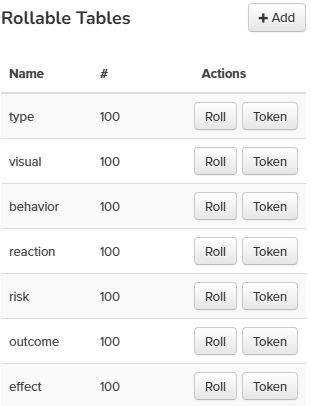
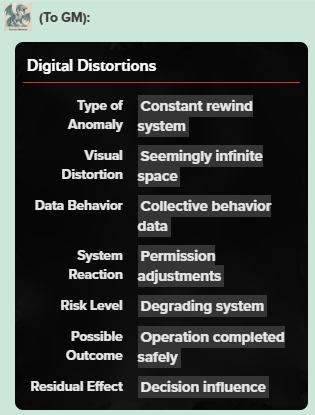
Set 5 generates anomalous digital environments and unstable data behaviors that transform a standard hacking session into a surreal and dangerous experience.
Instead of interacting with structured systems, the hacker navigates:
This set shifts the tone from infiltration to exploration of the unknown.
Corrupted fragments, recursive loops, paradoxical structures, emergent anomalies, reality-breaking architectures.
Shifting geometry, infinite corridors, collapsing UI layers, fragmented visual overlays, glitch-based environments.
Static, reactive, self-rewriting, adaptive, evolving into autonomous patterns.
Passive observation, defensive reconfiguration, deceptive manipulation, aggressive response.
Low instability, escalating system pressure, high-risk corruption zones, critical anomaly fields.
Access granted, partial corruption, system escalation, forced ejection, transformation event.
Lingering signals, cognitive distortion, persistent connection, data imprint, irreversible mental impact.
This is not a hacking toolkit.
This is an encounter generator.
Set 5 introduces:
It is designed to create tension, mystery, and unease.
The hacker is no longer just accessing data.
They are entering something that:
Perfect for:
Works especially well when you want:
Set 5 transforms hacking into a story engine.
Every interaction becomes:
The system is no longer a tool.
It is a place.
And something inside it might already be aware of you.
License: Roll20 End User License Agreement
(Personal Use Only, Do Not Distribute)