
Play Now
Join a Game
Characters
Shop
Tools
Compendium
Community

Sign In

Play Now
Join a Game
Characters
Shop
Tools
Compendium
Community
Sign In
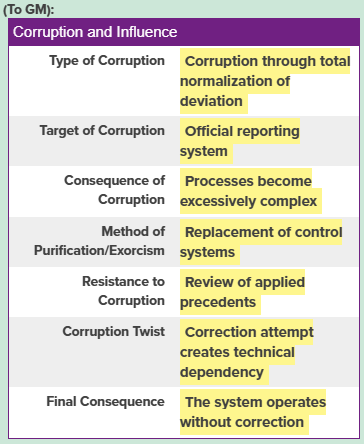
Set 4 explores corruption not as a sudden collapse or moral failing, but as an administrative process — gradual, rationalized, and often seen as functional within the system.
Here, corruption begins as acceptable exceptions, adapts to oversight, resists purification efforts, and eventually redefines what the system considers normal, efficient, or successful.
This set reveals that Hell does not need to destroy institutions.
It merely degrades them — just enough to keep them running, so they continue to justify their own existence.
This set is not about obvious villains or overt evil.
It’s about functional decay and the invisible mechanisms that sustain it.
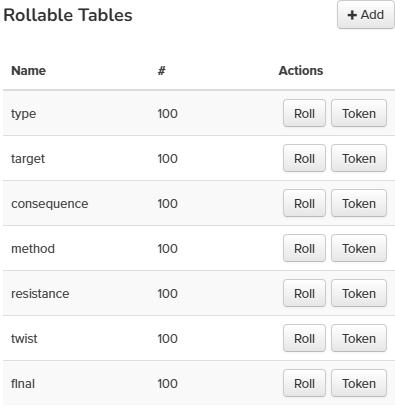
From nepotism and data manipulation to procedural dilution, performance inflation, and spiritual rot.
Which part of the system is compromised — departments, doctrines, individuals, contracts, audits, or ideals.
Gradual impacts on processes, metrics, relationships, decision-making, and institutional memory.
Bureaucratic rituals, symbolic reforms, scapegoating procedures, or audits — often ineffective or counterproductive.
Real attempts to restore integrity — from whistleblowers to rogue clerks — each with political and institutional consequences.
How the corruption adapts, migrates, or reveals a deeper layer — becoming harder to isolate or expunge.
How the system responds: normalization, absorption, or collapse disguised as efficiency.
Use these tables not to punish, but to show how corruption becomes part of the machine.
License: Roll20 End User License Agreement
(Personal Use Only, Do Not Distribute)